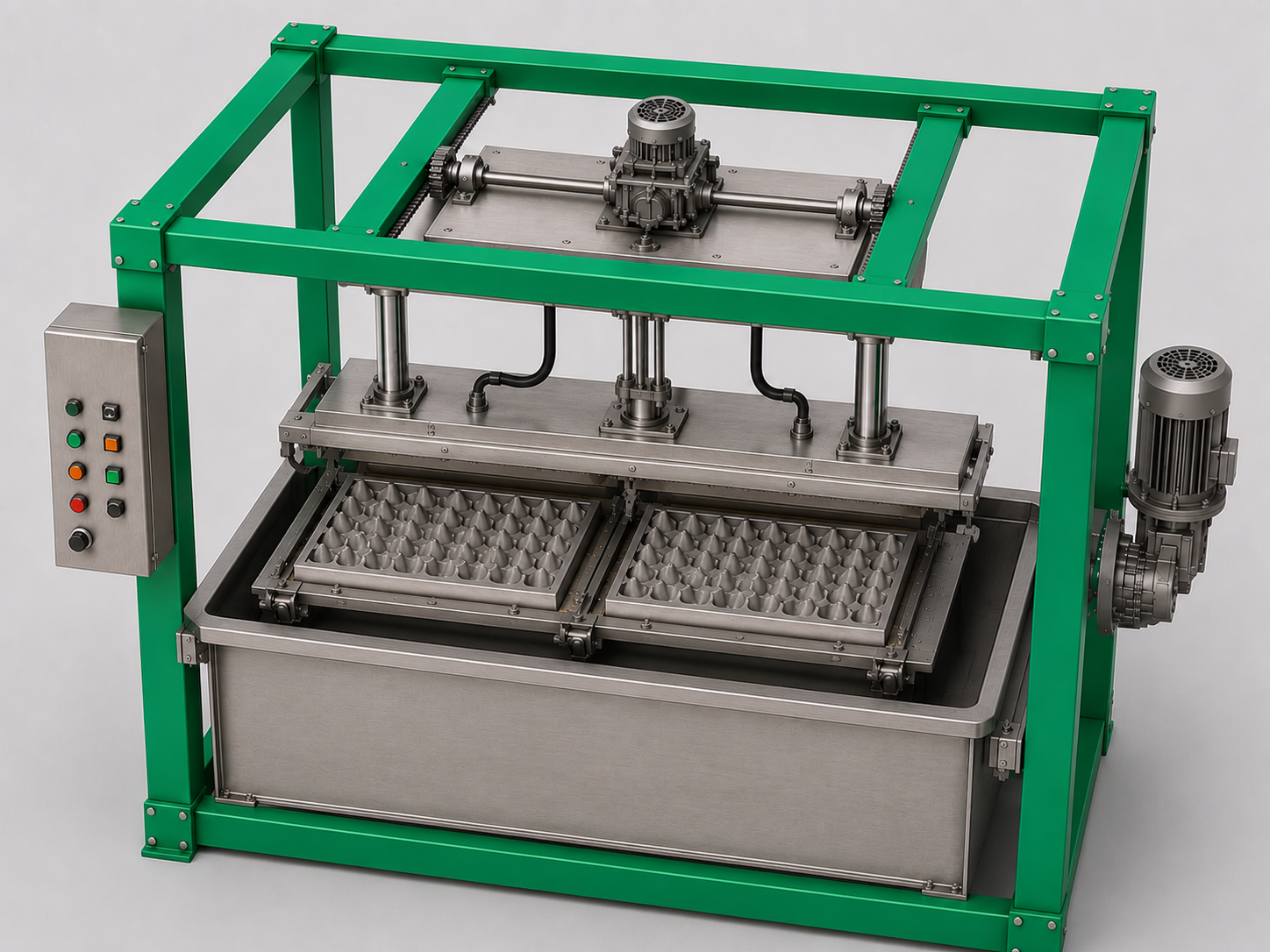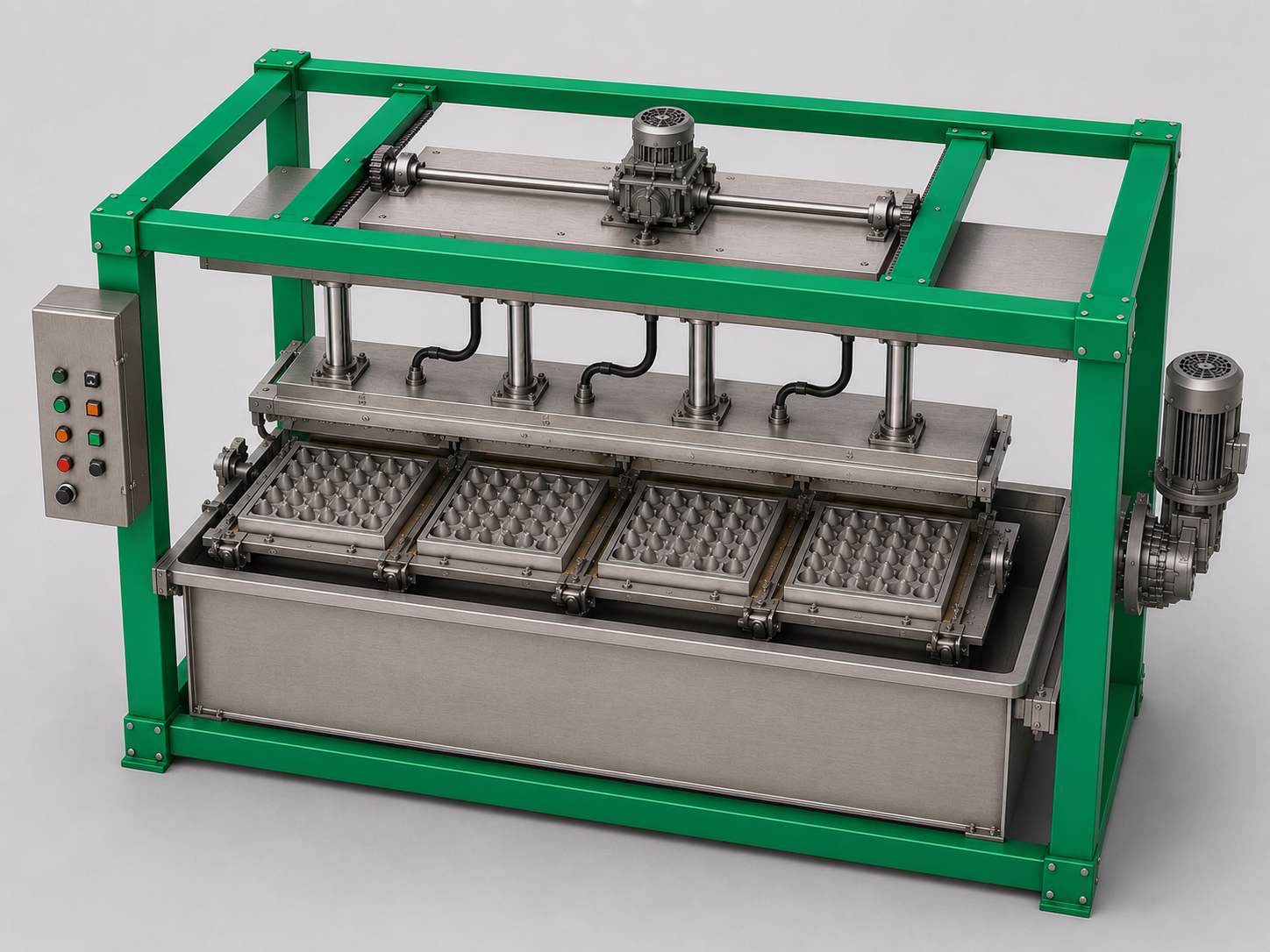
The ECPS-900E extends the compact range with a third mould station, lifting the rated reference capacity to 900 standard 30-egg trays per hour while keeping a compact site profile.
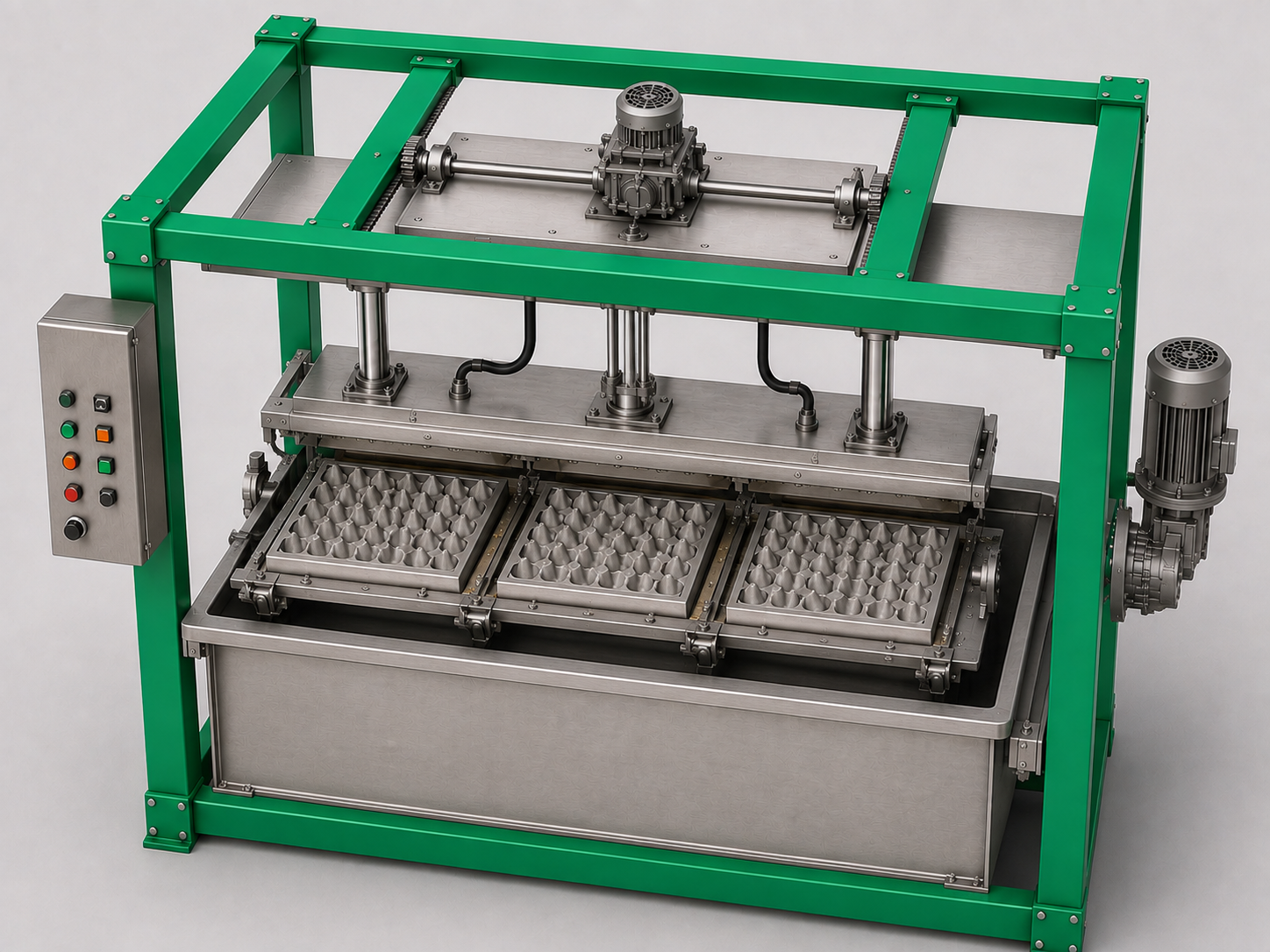
The ECPS-900E is the compact range at higher output. The third mould station adds production headroom without changing the platform concept, so the engineering approach, training and spare-parts planning stay consistent with the rest of the ECP family.
For a producer growing out of a first line, the ECPS-900E is a practical intermediate step — compact to operate, with capacity reserved for the next stage of demand.
The ECPS-900E suits producers who want the practicality of the compact platform with more output headroom than the ECPS-600E — a natural step for growing local production.
Capacity reference: standard 30-egg tray · reference mould module 320 × 320 mm.
Recovered paper or approved fiber is mixed with water and prepared as a stable pulp suspension.
Fiber is deposited on product-specific mesh moulds using vacuum. Process water is recovered into the closed water circuit.
Wet molded products are transferred from the forming moulds into the downstream carrier system.
Products are dried to the required moisture level and proceed to collection and downstream handling.
Pulper, mixers, tanks and pulp transfer sized for the compact-plus output range.
Vacuum-assisted dewatering with return-water circulation and a closed-loop process-water concept.
Product-specific molds with synchronized forming and transfer into the downstream carrier system.
PLC-based sequencing, operator interface and electrical protection configured for the project.
Insulated industrial dryer concept with forced hot-air circulation, sized for the production moisture load.
The ECP platform is a molded-fiber production system. Product geometry is mould-specific, and transfer interfaces and process parameters are configured for the approved product.
The ECPS-900E produces egg trays and molded-fiber products that fit the compact mould module. Product geometry is mould-specific and configured per approved product.
The ECP platform is a molded-fiber production system, not a single product machine. Product geometry is mould-specific; the platform adapts.
Bespoke molded-fiber products designed around a specific geometry and use — from industrial components to tailored packaging solutions.
Learn more — Custom Molded-Fiber ProductsMolded-fiber egg trays for the safe transport and storage of eggs — the reference product of the ECP platform, produced at every capacity level.
Learn more — Molded-Fiber Egg TraysMolded-fiber trays for fruit, vegetables and food handling — ventilated, food-appropriate packaging produced on the ECP platform.
Learn more — Food and Produce TraysCustom molded-fiber inserts and protective packaging for industrial and consumer goods — engineered cushioning that replaces expanded-polystyrene and plastic inserts.
Learn more — Protective Molded-Fiber PackagingEvery line is configured for the specific project:
Rated capacities reference a standard 30-egg tray with a 320 × 320 mm mould module. Actual output depends on product geometry, pulp recipe, moisture target, drying conditions, mould configuration and the final project specification.
Need higher capacity or production redundancy? Ask GDM about multi-line project configurations.
Dual-Line Egg Tray Production EngineeringSend us your target product, capacity and site conditions. We respond with the line configuration that fits.