
Industrial molded-fiber production lines — from compact 600 trays/hour to high-capacity 2,200 trays/hour. Automatic cycle, closed-loop water, engineered as a complete line.
Every GDM ECP line follows four connected stages: pulp preparation, vacuum forming, synchronized transfer and controlled drying in a metal dryer. Capacity increases through appropriately sized supporting systems.
Recovered paper and water are processed in the pulper, two primary tanks and one secondary tank. Process water circulates in a closed loop with typical monthly make-up of about 20% due mainly to evaporation.
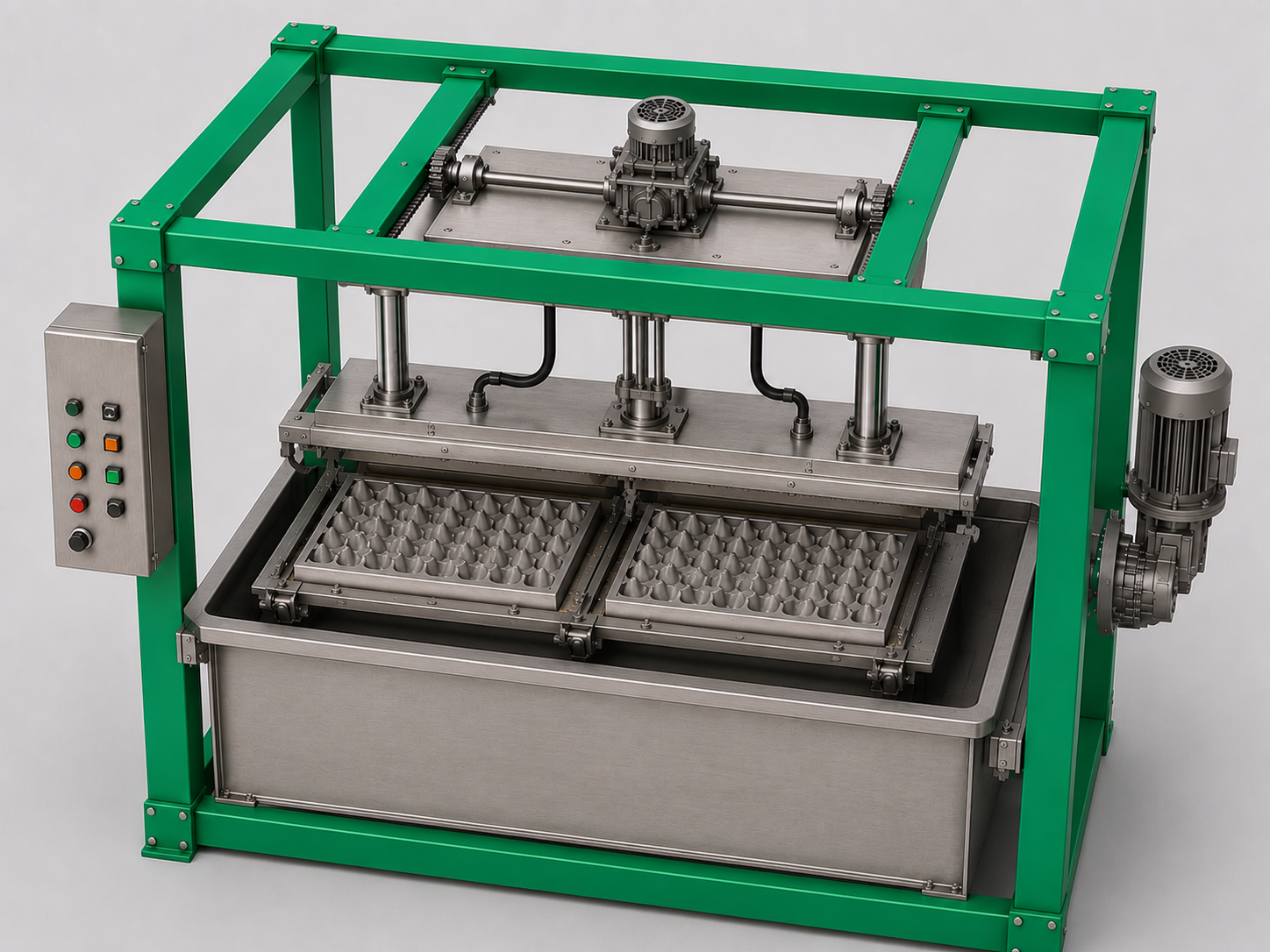
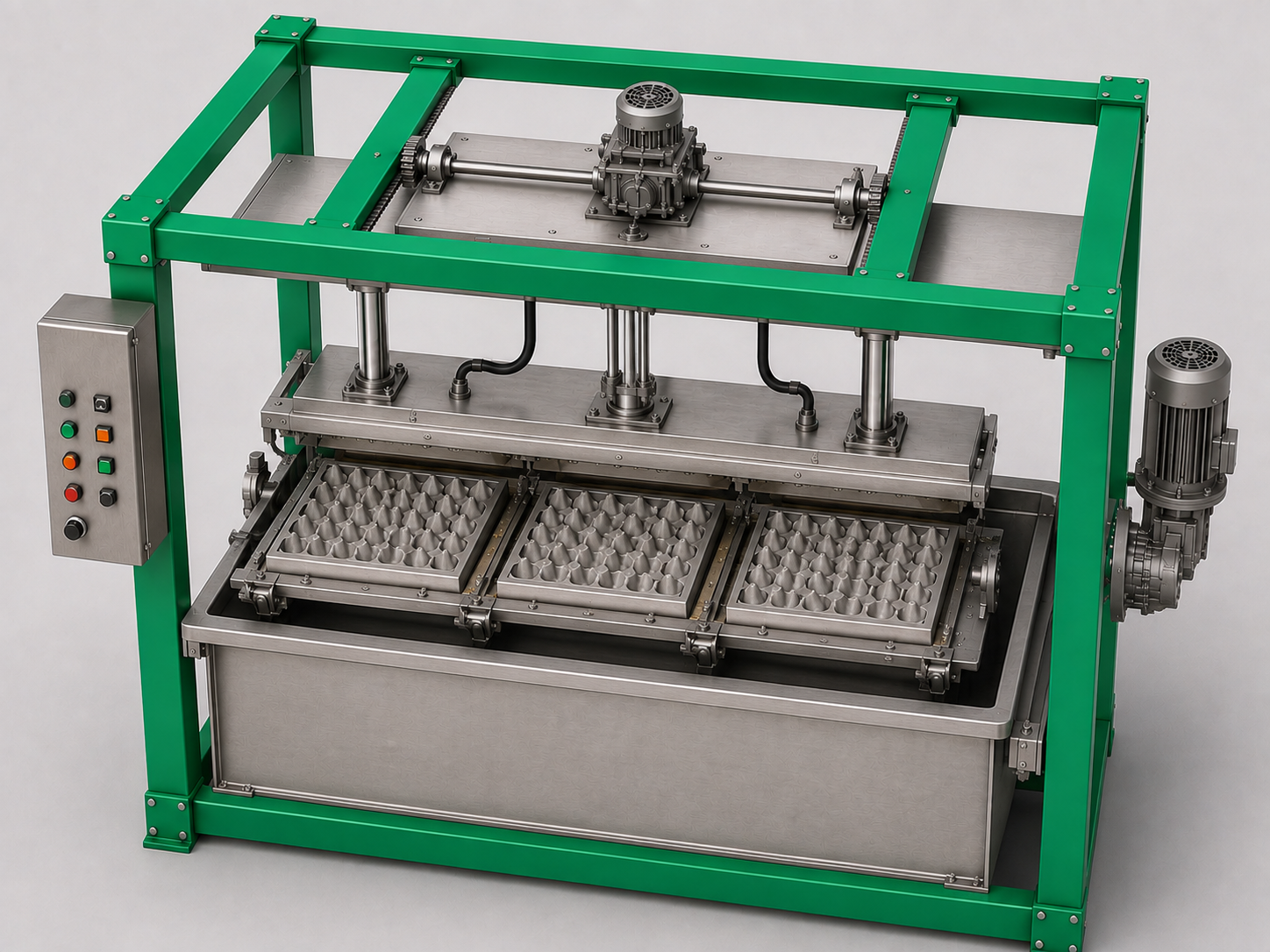
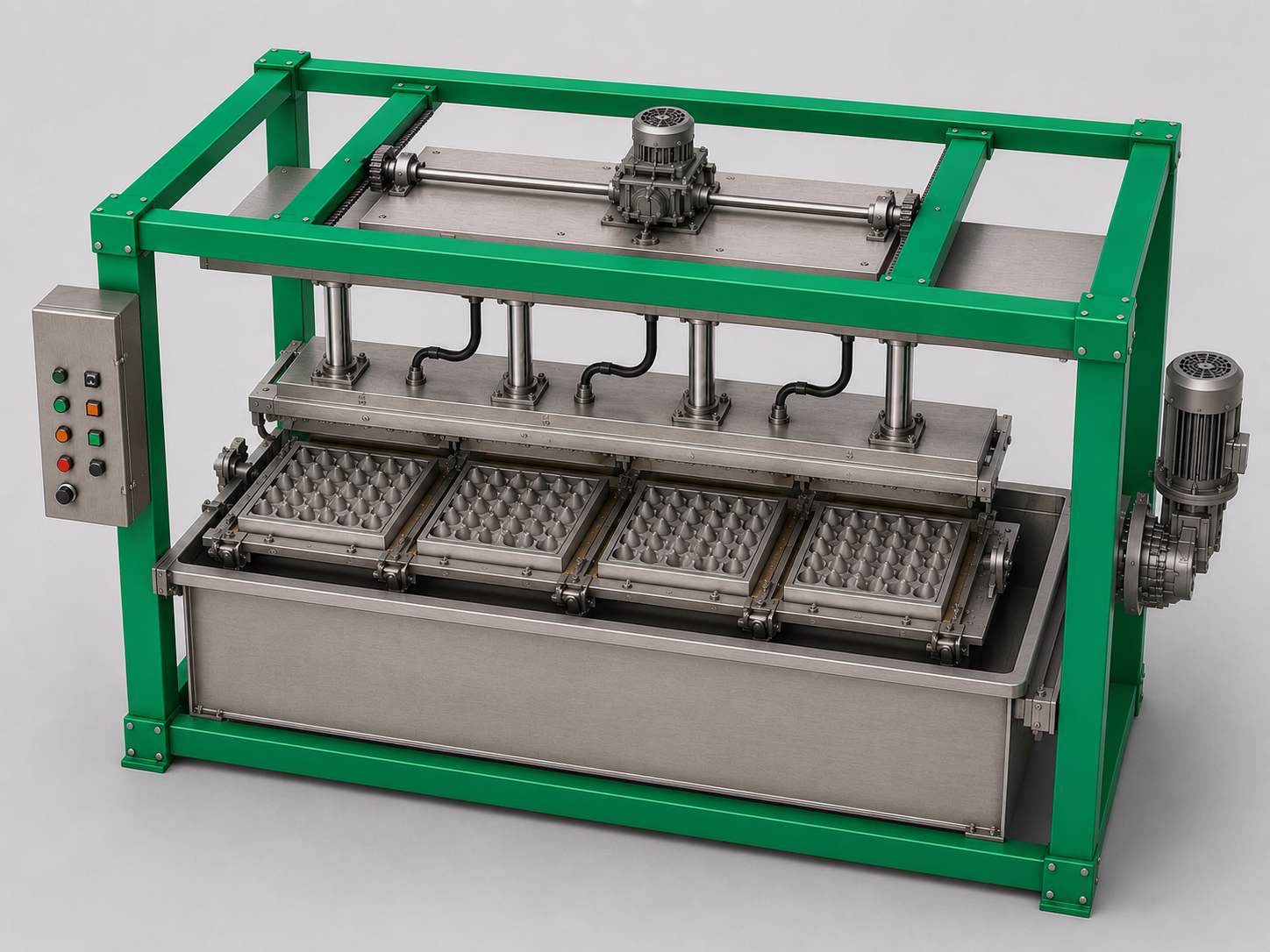
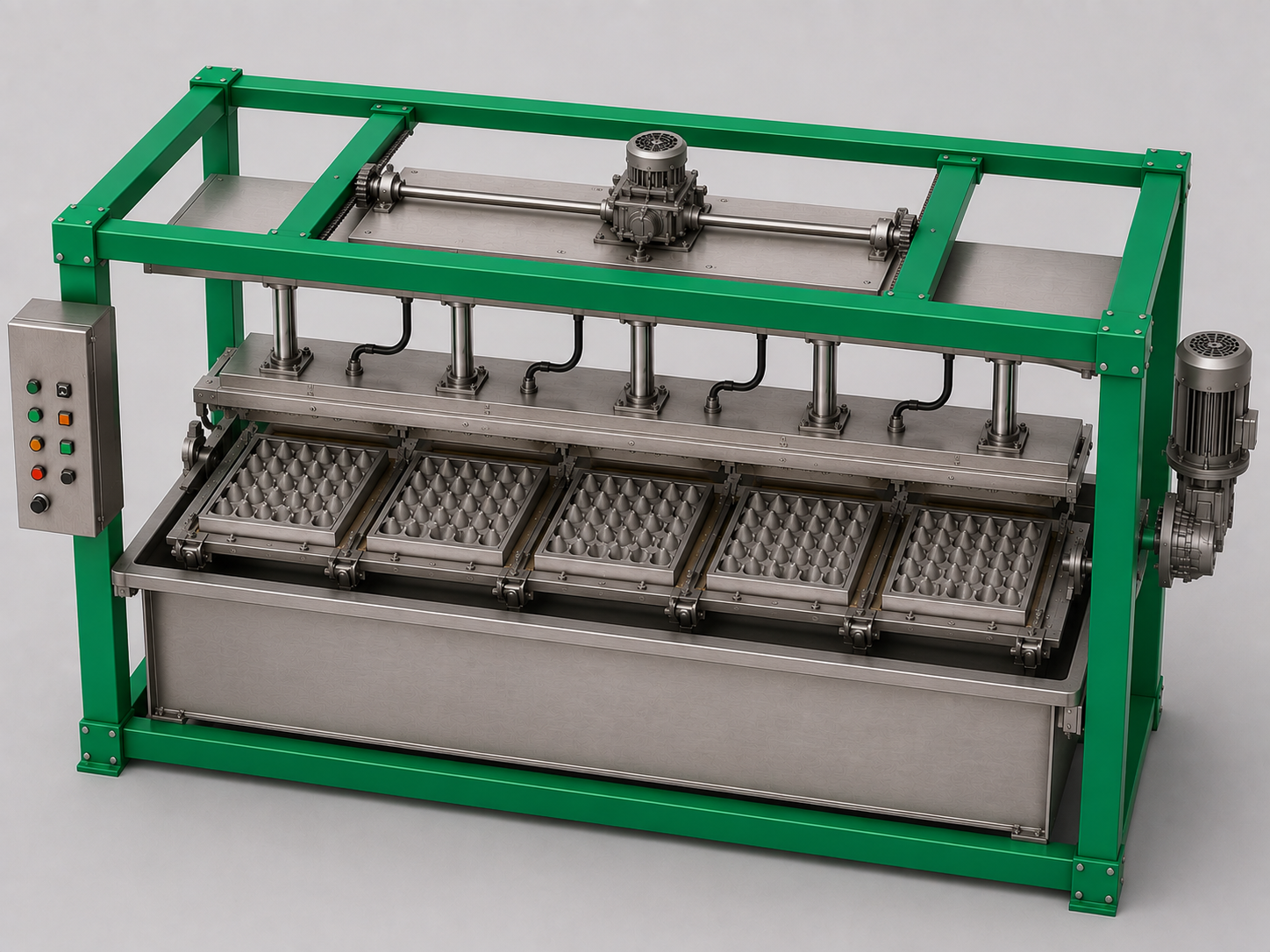
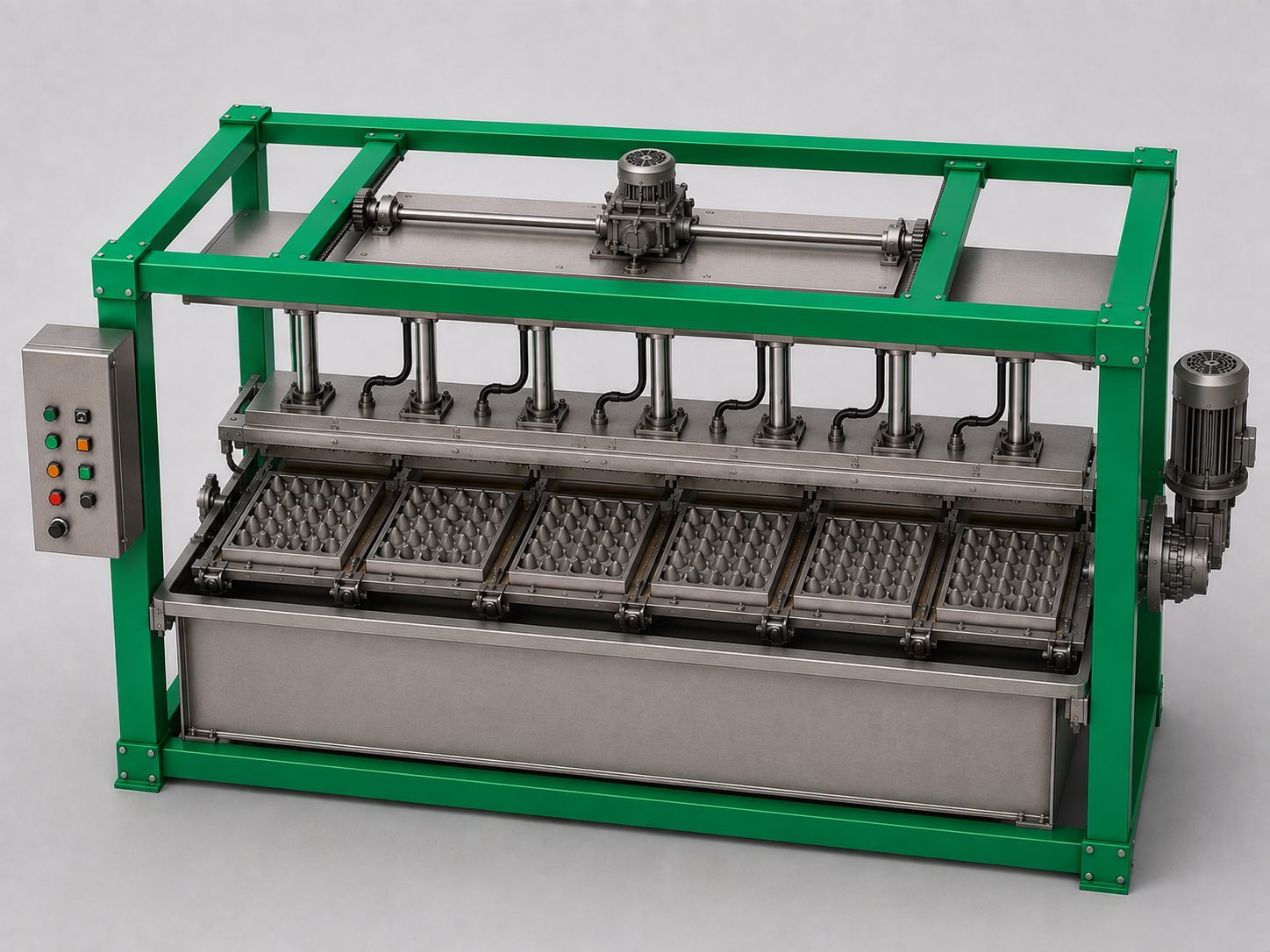
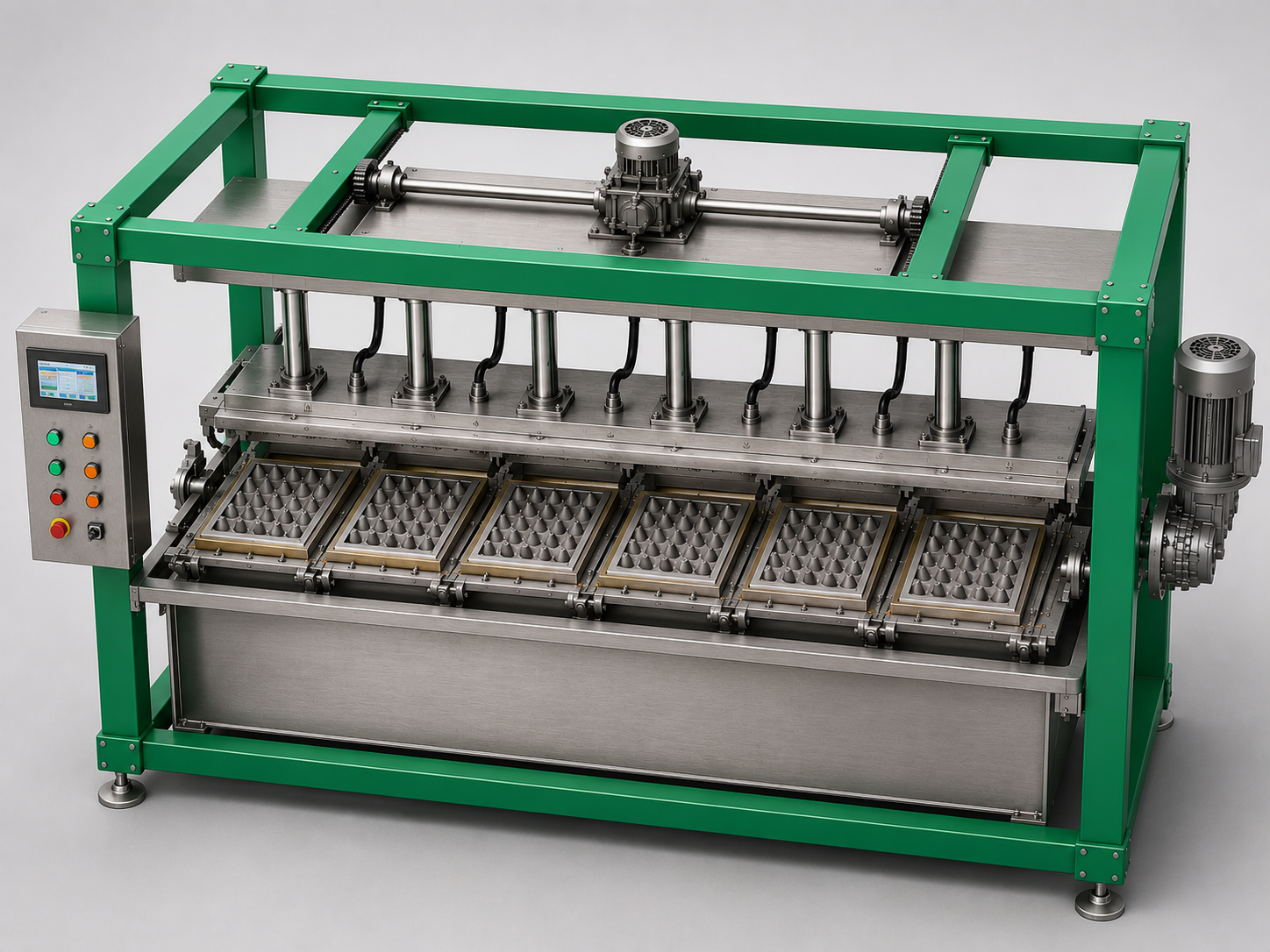
Product-specific mesh moulds use vacuum-assisted dewatering with return-water recovery. Schneider PLC control includes an approximately 10.1-inch HMI, electrical protection and phase-loss protection.
An insulated metal body, air circulation turbine, transfer and spare trays, and a model-dependent burner provide forced hot-air drying to the required moisture level.
Supporting systems include the vacuum pump, chiller, air compressor, high-pressure washing system, control panel and PLC. Typical sequence: pulper → primary tanks → secondary tank → forming machine → control panel → air compressor → vacuum pump → metal dryer.
Six models form three production families. They share one ECP platform architecture and differ by output and site-resource requirements.
600–900 trays/hour, 2–3 stations, 150 m², 2–3 workers, 65–75 kW maximum demand and 3–4 m³ initial water fill. A compact entry for new or local production.
Explore ECPS →1,200–1,500 trays/hour, 4–5 stations, 180 m², 2–3 workers, 110–140 kW maximum demand and 5–6 m³ initial water fill. Balanced commercial production.
Explore ECPM →1,800–2,200 trays/hour, 6 stations, 200 m², 3–4 workers, 160–200 kW maximum demand and 7–9 m³ initial water fill. Designed for industrial continuous operation.
Explore ECPL →Rated output uses the standard 30-egg tray (320 × 320 mm) as the comparison reference. Actual output varies with mould, geometry, material and line configuration.
| Model | ECPS-600E ECPS | ECPS-900E ECPS | ECPM-1200E ECPM | ECPM-1500E ECPM | ECPL-1800E ECPL | ECPL-2200E ECPL |
|---|---|---|---|---|---|---|
| Rated output | 600 trays/hour | 900 trays/hour | 1,200 trays/hour | 1,500 trays/hour | 1,800 trays/hour | 2,200 trays/hour |
| Family | ECPS — Compact | ECPS — Compact+ | ECPM — Medium | ECPM — Medium+ | ECPL — High capacity | ECPL — Maximum standard output |
| Mould stations | 2 | 3 | 4 | 5 | 6 | 6 |
| Water — initial fill | 3 m³ | 4 m³ | 5 m³ | 6 m³ | 7 m³ | 9 m³ |
| Max electrical | 65 kW | 75 kW | 110 kW | 140 kW | 160 kW | 200 kW |
| Workers/shift | 2–3 | 2–3 | 2–3 | 2–3 | 3–4 | 3–4 |
| Recommended area | 150 m² | 150 m² | 180 m² | 180 m² | 200 m² | 200 m² |
Indicative guidance — final sizing is confirmed against your product and site conditions. Choose the band closest to your target output.
Compact entry line. 150 m², 2–3 workers, 65–75 kW max, 3–4 m³ initial water. Best for first lines or regional demand.
Start here when establishing production; expand to ECPM when approaching 900/hour.
Medium commercial line. 180 m², 2–3 workers, 110–140 kW max, 5–6 m³. Steady commercial output with growth headroom.
Upgrade from ECPS when regular output exceeds 900/hour.
First industrial 6-station line. 200 m², 3–4 workers, 160 kW max, 7 m³. High-volume continuous operation begins here.
Gateway to large production; same 6-station platform as ECPL-2200E with smaller supporting systems.
Maximum standard output. 200 m², 3–4 workers, 200 kW max, 9 m³. Largest supporting systems in the standard range (+50% vacuum, +20% burner vs ECPL-1800E).
Top of the standard range; consider dual-line when a single line ceiling is reached.
Capacity varies with product geometry, pulp recipe, moisture target, drying and mould configuration. Final figures confirmed with a project specification. If in doubt, request engineering confirmation.
The same machine platform can produce egg trays, egg cartons, fruit trays, cup carriers and other molded recycled-paper packaging by changing compatible product-specific moulds.
The mould is the principal product-change mechanism. Transfer interfaces and operating parameters are configured for each approved product.
3–9 m³ is the initial fill for the process-water circuit, not hourly consumption. Water is recirculated, with periodic make-up of about 20% per month due mainly to evaporation under typical conditions.
65–200 kW is maximum startup/peak electrical demand, not continuous energy consumption. ECPL burner thermal power of 425–510 kW is a separate engineering quantity.
The machine cycle is automatic, but the factory remains staffed. Typical line operation requires 2–3 workers per shift for ECPS/ECPM and 3–4 for ECPL.
Send us your target product, capacity and site conditions. We respond with the line configuration that fits.